Why Japan Is at the Center of the Virtual Influencer Economy
From VTubers to virtual idols, Japan has transformed digital characters into a global entertainment business. Explore the culture, companies, technology, and economics behind the rise of virtual influencers.
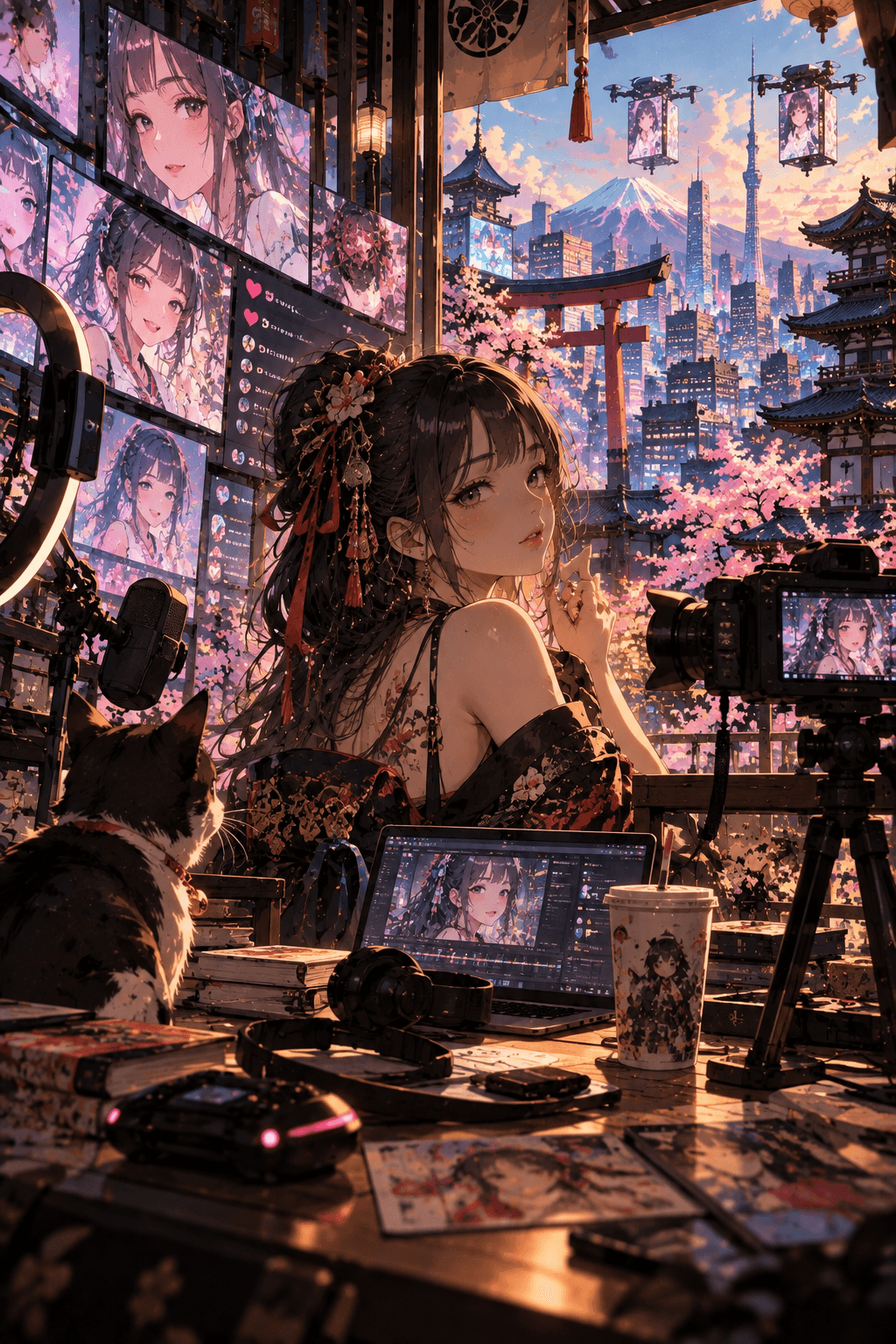
Why Japan Is at the Center of the Virtual Influencer Economy
How VTubers, virtual idols, digital fandoms, and character-driven entertainment are reshaping the global creator economy.
Imagine a concert where thousands of people wave glowing light sticks toward a performer who has never physically existed in the form they see onstage. The audience sings along, buys merchandise, shares clips online, and develops a genuine emotional attachment to the character.
Now imagine that the performer can also stream video games, collaborate with other entertainers, release original music, appear in advertisements, and build a fan community across several continents.
This is no longer a speculative vision of digital entertainment. It is an established part of Japan's cultural economy.
From the early success of Hatsune Miku to the international expansion of Hololive and Nijisanji, Japan has developed an entertainment ecosystem in which fictional appearances and human performances coexist. Digital characters have become commercial properties, creative identities, and, in some cases, internationally recognizable celebrities.
The significance extends beyond anime or gaming. Japan's virtual entertainment industry offers a glimpse into how identity, intellectual property, audience participation, and human creativity may evolve across the wider internet.
The central question is not simply why people watch animated characters.
It is why Japan has been particularly successful at turning those characters into enduring entertainment businesses—and what the rest of the world can learn from that model.
What Is a Virtual Influencer?
A virtual influencer is a digitally represented personality that attracts an audience and influences its behavior, preferences, or purchasing decisions.
However, the term encompasses several different technologies and business models.
A computer-generated fashion personality posting carefully produced images on Instagram is not necessarily the same kind of performer as a Japanese VTuber broadcasting live on YouTube.
The distinction matters.
Virtual Influencers, VTubers, and AI Personalities
Type | How it works | Typical content |
|---|---|---|
VTuber | A human performer controls an animated avatar, often using face or motion tracking | Live streams, gaming, music, conversations |
Virtual idol | A fictional character performs through animation, synthesis, recorded performances, or live production | Concerts, songs, merchandise |
CGI influencer | A digitally designed personality appears in produced social media content | Fashion, advertising, lifestyle |
AI-powered personality | Software generates some or all conversational or expressive behavior | Interactive chats, autonomous streams, digital companionship |
These categories overlap, but they should not be treated as interchangeable.
Most established Japanese VTubers are not autonomous artificial intelligences. They are human entertainers whose performances are expressed through digital characters.
The voice, humor, timing, emotional reactions, and creative decisions generally come from real people.
The avatar changes the presentation of the performer. It does not eliminate the performer.
This difference helps explain why VTubers can build strong relationships with their audiences.
Fans are often responding to genuine human spontaneity, even when the face on the screen belongs to a fictional character.
The avatar may be fictional, but the performance, community, and economic relationships surrounding it are real.
Japan's Cultural Advantage: Characters Were Already Celebrities
To understand Japan's influence on virtual entertainment, it is necessary to look beyond streaming technology.
Japan had spent decades developing a sophisticated commercial culture around fictional characters before VTubers became popular.
Anime, manga, video games, collectible merchandise, music, and character licensing established a familiar relationship between audiences and fictional personalities.
Characters could become recognizable cultural figures without having a conventional human celebrity behind them.
The Character as an Independent Cultural Identity
A character such as Hello Kitty demonstrates an important principle: an entertainment identity does not need to be attached to a single actor or public personality to become commercially valuable.
Its visual design, emotional associations, and cultural meaning can be maintained across products, media, and generations.
Japanese entertainment companies have repeatedly developed characters as intellectual properties capable of moving between formats.
A fictional identity might begin in a game, appear in an animated series, release music, become a collectible figure, and eventually feature in advertising campaigns.
This model is often called media mix.
Rather than treating each entertainment product as an isolated commercial offering, media mix connects multiple forms of content around a shared character or fictional universe.
The audience's attachment to the character becomes the foundation for repeated engagement.
Virtual entertainers are a natural extension of this system.
They combine the established Japanese character economy with the immediacy of modern livestreaming.
The Importance of Fan Participation
Japan's fan communities have also developed traditions of collecting, creative participation, and sustained support for particular characters or performers.
Fan art, fan fiction, conventions, music remixes, collectibles, and online communities allow audiences to participate in a fictional world rather than simply consume it.
This participation is particularly important for VTubers.
A fan might discover a character through a short gaming clip, watch a livestream, join a membership community, create fan art, purchase merchandise, and eventually attend a concert.
Each activity strengthens the connection between the fan and the character.
The result is not merely an audience.
It is an ecosystem of repeated cultural and economic participation.
Hatsune Miku: The Foundation of the Virtual Idol Economy
Before VTubers became international streaming personalities, Hatsune Miku had already demonstrated that a digitally represented performer could sustain an extraordinary entertainment career.
Introduced in 2007 by Crypton Future Media as a character associated with singing-synthesis software, Miku became far more than a software mascot.
Her success was built around a remarkable creative arrangement.
Rather than depending entirely on a conventional record label or a single songwriter, Miku became a recognizable voice and character through which numerous creators could produce music.
Independent musicians wrote songs.
Illustrators created artwork.
Animators produced videos.
Fans shared performances, remixes, and interpretations.
The character became a shared creative reference point.
A Different Relationship Between Artist and Audience
In conventional popular music, the artist generally performs the work and the audience consumes it.
Miku's ecosystem complicated that relationship.
The character's identity remained recognizable, but many different creators contributed to the cultural body of work associated with her.
This distributed creative process helped generate an unusually broad musical universe.
Different songs could express entirely different moods, genres, and narratives while remaining connected through the same recognizable performer.
The audience did not simply follow an artist's career.
It participated in the construction of that career.
This is one of the most important precedents for today's virtual entertainment economy.
From Software to Concerts
Hatsune Miku's expansion into live concerts demonstrated another important commercial possibility.
A digital character could attract audiences to physical venues.
People were willing to buy tickets, travel, purchase merchandise, and share a collective experience centered on a virtual performer.
The concert was not valuable because audiences believed Miku was physically human.
It was valuable because the music, spectacle, community, and emotional attachment were meaningful.
That distinction remains central to understanding the VTuber industry.
Virtuality does not necessarily reduce the emotional value of entertainment.
Under the right circumstances, it can create new forms of participation.
The VTuber Revolution: From Kizuna AI to Global Streaming
The modern VTuber movement accelerated during the second half of the 2010s.
Kizuna AI, who debuted in 2016, became one of the most influential early figures associated with the term Virtual YouTuber.
Her videos introduced international audiences to a personality who communicated through an animated digital body while adopting the familiar conventions of online creators.
She spoke directly to viewers, participated in internet culture, and built an entertainment identity that could function across linguistic and cultural boundaries.
The character design attracted attention, but personality and performance sustained interest.
This combination became fundamental to the broader industry.
Why Livestreaming Changed Everything
Pre-produced virtual character videos require substantial planning and production.
Livestreaming offers a different relationship.
Audiences can observe unexpected events, spontaneous jokes, emotional reactions, and interactions between performers.
These moments are particularly effective in creating a sense of familiarity.
A viewer who watches a VTuber for several hours each week may develop a stronger sense of connection than someone who occasionally encounters a carefully edited advertisement featuring a CGI influencer.
Live chat adds another dimension.
Viewers can react in real time, send messages, participate in recurring jokes, and sometimes influence the direction of a broadcast.
The entertainment experience becomes partly collaborative.
That is why VTubers should not be understood simply as animated celebrities.
They are also community-centered digital performers.
Hololive: Building a Global Entertainment Franchise
One of the clearest examples of the industry's development is Hololive Production, operated by Japan's COVER Corporation.
Hololive combines individual streaming personalities with a coordinated entertainment and intellectual-property business.
Its performers participate in gaming broadcasts, conversations, musical releases, concerts, collaborations, and promotional activities.
Some audiences primarily follow individual personalities.
Others engage with the wider group and its interconnected character relationships.
Both forms of engagement are commercially significant.
From Streaming Channels to an Entertainment Network
COVER reported that, as of June 2026, Hololive Production had 78 VTubers across its operating groups, approximately 95.2 million combined YouTube channel subscriptions, and 25 billion cumulative YouTube views.
The company also reported 45 VTubers with at least one million channel subscribers.
These figures illustrate the scale of the network, but they require an important qualification.
Combined channel subscriptions are not the same as unique individual fans. One person may subscribe to multiple performers.
Even with that distinction, the figures demonstrate that the business extends far beyond a small entertainment niche.
The Value of Interconnected Characters
Hololive's structure allows characters to participate in shared events, collaborations, and group activities.
A viewer may discover one performer and subsequently become interested in several others.
This creates a form of audience circulation within the network.
Collaborations introduce existing fans to new personalities.
Group concerts encourage cross-community participation.
Merchandise collections can appeal to audiences interested in the broader brand.
The company therefore benefits from both individual performer popularity and the cumulative identity of the network.
Why the Business Is More Than YouTube
The economics of a large VTuber agency cannot be understood through advertising revenue alone.
COVER's business encompasses streaming, live entertainment, merchandise, licensing, and broader character-based projects.
Its financial reporting for the year ended March 2026 showed approximately ¥49.3 billion in revenue.
Merchandise represented a particularly important part of the business.
This demonstrates a significant shift in the underlying model.
The company is not simply monetizing attention through video advertisements.
It is transforming audience attachment into demand for products, events, music, and licensed experiences.
That distinction is fundamental to the virtual influencer economy.
A livestream may introduce the audience to a character.
The broader intellectual-property ecosystem creates additional ways for that relationship to generate revenue.
Nijisanji: A Different Approach to the Same Opportunity
Nijisanji, operated by ANYCOLOR, is another major Japanese VTuber business.
Although it operates within the same broad industry as Hololive, its talent portfolio, programming, branding, and commercial activities have developed their own characteristics.
Nijisanji illustrates how virtual entertainment can accommodate a large variety of personalities and performance styles.
Different performers attract audiences through gaming, music, humor, conversation, competitive events, or collaborative entertainment.
The model allows viewers to form preferences around particular entertainers rather than requiring every personality to conform to one artistic identity.
A Scalable Talent Network
The economic logic of a large VTuber network resembles certain aspects of talent management, media production, and character licensing.
The agency can provide infrastructure that would be difficult for many independent performers to develop alone.
This may include technical support, production management, merchandise operations, business partnerships, and event organization.
In return, the company participates in the commercial value created around its performers and associated intellectual property.
ANYCOLOR reported approximately ¥55.7 billion in revenue for its fiscal year ended April 2026.
Together, the financial results of ANYCOLOR and COVER provide evidence that Japanese VTuber entertainment has developed into a substantial commercial industry.
However, these figures should not be added together and presented as the total Japanese VTuber market.
They are company revenues, not comprehensive industry measurements, and their fiscal reporting periods differ.
Competition Creates an Industry
The coexistence of major agencies also matters.
Competition encourages experimentation in talent development, performance formats, merchandise, technology, and international expansion.
It gives creators and audiences multiple ways to participate in virtual entertainment.
At the same time, large agencies face familiar entertainment-industry challenges: talent retention, production costs, intellectual-property management, reputational risks, and the difficulty of sustaining audience engagement over time.
Virtual entertainment changes the presentation of celebrity.
It does not eliminate the business challenges associated with managing celebrities.
How the Virtual Influencer Economy Actually Makes Money
The commercial structure of virtual entertainment is more diverse than the phrase influencer marketing suggests.
Advertising and sponsorships matter, but they represent only part of the potential revenue.
1. Streaming and Platform Monetization
VTubers can earn money through platform advertising, paid memberships, viewer contributions, and other features supported by streaming services.
The precise revenue distribution depends on platform terms, agency agreements, and individual arrangements.
A creator's visible audience size therefore cannot be converted directly into a reliable personal income estimate.
2. Merchandise and Collectibles
Character merchandise is one of the industry's most distinctive advantages.
A digital performer can generate demand for physical products.
These may include figures, plush toys, apparel, accessories, trading cards, and limited-edition collectibles.
Merchandise creates a bridge between an intangible digital identity and tangible consumer ownership.
It also allows fans to express affiliation outside the original streaming platform.
3. Concerts and Live Events
Virtual performers can appear in live events using advanced animation, real-time performance systems, screens, and other stage technologies.
The production may combine human musical performances, recorded elements, digital animation, and live interaction.
Audiences pay for the overall experience.
Revenue opportunities include ticketing, associated merchandise, and event partnerships.
However, large productions can also involve substantial venue, staffing, technical, and logistical costs.
4. Brand Partnerships and Licensing
Brands can collaborate with virtual performers to reach established fan communities.
These arrangements may involve promotional appearances, branded merchandise, product collaborations, or licensing agreements.
For businesses, the attraction is not simply that a character looks unusual.
It is access to a recognizable identity with a specific audience.
5. Music and Intellectual Property
Original songs, albums, music videos, games, and animated productions allow characters to exist beyond regular livestream schedules.
Successful characters can therefore become the foundations of broader entertainment franchises.
This is where Japan's established media-mix expertise becomes particularly valuable.
A VTuber is not necessarily limited to being a person who streams.
The character can become the center of a connected portfolio of creative products.
In virtual entertainment, attention creates the audience, but intellectual property creates opportunities for that audience relationship to extend beyond the original platform.
Why Fans Become Emotionally Attached to Virtual Characters
The emotional appeal of VTubers is sometimes misunderstood.
A common assumption is that viewers are attracted primarily to the visual design.
Character design certainly matters.
It establishes an immediate identity, creates aesthetic appeal, and helps a performer stand out.
But sustained engagement usually depends on something more complex.
Personality Still Matters
Viewers may return because they enjoy a performer's humor, musical ability, conversational style, gaming skills, or interactions with other creators.
The animated avatar can become familiar in much the same way as a conventional entertainer's appearance.
Over time, recognizable gestures, expressions, and recurring jokes contribute to the character's identity.
The audience develops expectations and emotional associations.
The Role of Parasocial Relationships
Media researchers use the term parasocial relationship to describe a one-sided sense of familiarity or connection that audiences may develop with media personalities.
These relationships are not unique to VTubers.
They also occur with musicians, actors, television presenters, and conventional social media influencers.
However, the combination of livestreaming, recurring audience interaction, fictional characterization, and community participation can make the experience particularly distinctive.
The relationship may feel personal even though the performer cannot maintain an individual reciprocal relationship with every viewer.
This creates both opportunities and responsibilities.
Communities can provide entertainment, shared identity, and meaningful social experiences.
They can also develop unhealthy expectations around personal access, emotional exclusivity, or financial support.
Responsible entertainment businesses must recognize both possibilities.
Anonymity and Creative Freedom
Digital avatars can offer performers some separation between their public entertainment identities and their private lives.
A performer may choose not to reveal their face or personal details while still building a recognizable career.
This can create opportunities for experimentation and self-expression.
Yet anonymity is not guaranteed.
Performers may still face harassment, privacy violations, contractual restrictions, and public pressure.
The avatar is a presentation layer, not a complete protection system.
Japan's Virtual Entertainment Is Becoming Global
Japan remains particularly influential in the development of VTuber entertainment, but the audience is no longer limited to Japanese-speaking viewers.
International expansion has created opportunities for performers working in English, Indonesian, and other languages.
Fan communities translate clips, share highlights, create artwork, and introduce performers to new audiences.
These activities can help cultural products travel internationally.
Why Localization Is More Than Translation
A successful international virtual performer does not necessarily need to imitate Japanese-language content.
Different audiences have different humor, streaming habits, cultural references, and expectations.
International talent networks therefore face a balancing problem.
They must preserve the recognizable appeal of their brands while allowing performers to develop personalities suited to their own audiences.
This is similar to the challenge faced by global entertainment franchises.
The brand needs consistency.
The performers need individuality.
The Importance of Fan Translation
Fan-made subtitles and short clips have played an important role in introducing Japanese VTubers to overseas audiences.
A viewer may encounter a translated highlight before watching a full livestream.
This creates a discovery pathway that does not depend entirely on official advertising.
However, fan translation also raises questions about accuracy, context, copyright, and permission.
A short translated clip may make a performer more accessible while also removing important context from the original broadcast.
Agencies and creators therefore need policies that encourage beneficial fan participation without surrendering control over how their work is represented.
Are AI Virtual Influencers the Next Stage?
Artificial intelligence is increasingly discussed as the next major development in digital entertainment.
AI systems can generate dialogue, synthesize speech, support animation, and create content with varying degrees of automation.
These capabilities raise the possibility of virtual personalities that operate with less direct human performance.
But an AI-powered character and a conventional VTuber are not the same thing.
Human Performance Versus Autonomous Behavior
A human-operated VTuber responds through the judgment, personality, and experience of the person controlling the avatar.
An AI personality may generate responses based on software systems, training data, programmed instructions, and real-time inputs.
Both can produce entertaining interactions.
However, the creative process and accountability structures differ.
An AI character may be available for longer periods or respond to many users simultaneously.
A human performer brings personal experience, improvisation, and social judgment that cannot simply be assumed to emerge from automation.
The most commercially interesting future may involve hybrid production systems rather than a complete replacement of human entertainers.
The Risks of Automated Personalities
AI-powered virtual entertainers introduce additional concerns.
These include misleading audiences about whether they are interacting with a human, generating inappropriate responses, reproducing protected voices or identities, and encouraging emotionally dependent interactions.
The commercial incentives are also complicated.
An always-available personality might generate substantial engagement, but that does not automatically make the experience healthy or trustworthy.
Transparency will become increasingly important.
Audiences should be able to understand whether a character is human-operated, AI-assisted, or substantially autonomous.
The Hidden Costs of Virtual Celebrity
Digital entertainment can appear inexpensive because its characters are not physically present in the same way as conventional celebrities.
In reality, professional VTuber operations can require substantial resources.
High-quality character models, animation rigs, tracking systems, streaming equipment, production staff, music arrangements, technical support, and marketing all carry costs.
Large events add further complexity.
An agency may need to coordinate animation, choreography, music, stage production, merchandising, ticketing, and international distribution.
These are real entertainment-industry expenses.
The Challenge of Talent Sustainability
VTubers can face demanding production schedules and strong expectations from fans.
Regular livestreaming, collaborations, promotional appearances, and music projects can create significant workloads.
A successful virtual identity may also become closely associated with a particular performer.
This creates difficult questions when performers leave agencies or retire from established characters.
Who owns the avatar?
Who controls the channel?
Can the performer continue using the identity?
What happens to the existing fan community?
The answers depend on contracts and intellectual-property arrangements.
There is no single universal rule.
These issues demonstrate why virtual entertainment should be understood as a labor and ownership question as well as a technological phenomenon.
Independent VTubers and the Democratization of Digital Performance
Although major Japanese agencies attract considerable attention, the industry also includes independent performers.
Independent VTubers may commission their own avatars, manage their channels, develop community relationships, and control more of their creative direction.
Accessible streaming software and consumer tracking technologies have reduced some technical barriers to entry.
A creator no longer necessarily needs a professional animation studio to begin experimenting with a virtual identity.
However, accessible tools do not guarantee commercial success.
Independent creators still need an audience, a distinctive identity, consistent production, and a sustainable financial model.
The market is competitive.
Discovery can be difficult.
And the costs of professional artwork, rigging, equipment, and production can accumulate.
Agency Versus Independent Creator
Consideration | Agency VTuber | Independent VTuber |
|---|---|---|
Creative control | Subject to contracts and brand policies | Potentially greater autonomy |
Technical resources | May receive organizational support | Usually self-managed or outsourced |
Marketing | Can benefit from an established network | Must build independent visibility |
Revenue | Subject to contractual sharing | Keeps revenue after applicable costs and fees |
Character ownership | Depends on contract, often agency-controlled | Depends on commissioned rights and agreements |
Business risk | Shared across an organization, but contractual dependencies exist | Greater direct operational responsibility |
Neither model is automatically superior.
The best arrangement depends on the performer's goals, resources, negotiating position, and preferred level of independence.
What the Global Creator Economy Can Learn From Japan
Japan's virtual entertainment industry provides several lessons for digital media businesses.
The first is that audiences can form lasting attachments to fictional identities when those identities provide consistent and meaningful entertainment.
The second is that intellectual property can become more valuable when it operates across several complementary formats.
The third is that community participation can support both cultural relevance and commercial longevity.
But perhaps the most important lesson concerns the relationship between technology and creativity.
The most successful virtual entertainment businesses do not rely on novelty alone.
They combine character design, performance, storytelling, production infrastructure, and audience understanding.
Technology enables the experience.
Human creativity gives audiences a reason to return.
A Model Beyond Entertainment
These principles may eventually influence other industries.
Educational platforms could develop recurring animated instructors.
Games could feature persistent personalities that interact across different experiences.
Brands might build digital representatives with recognizable histories and communities.
Museums and cultural institutions could experiment with character-led interpretation.
Yet these possibilities should not be confused with established commercial outcomes.
A virtual character becomes valuable only when it serves a genuine audience need.
An attractive avatar without compelling content is unlikely to sustain a meaningful community.
The Future of Virtual Influencers: Identity Becomes a Creative Medium
The next stage of virtual entertainment will likely involve more sophisticated animation, broader international collaboration, improved production tools, and increasing experimentation with AI.
But the industry's development will also depend on less glamorous questions.
Can agencies create sustainable working conditions?
Can independent performers protect their identities and intellectual property?
Can platforms support healthy community relationships?
Can companies diversify revenue without exhausting their audiences?
And can virtual personalities remain creatively compelling once the novelty of animated presentation becomes ordinary?
These questions will determine whether virtual entertainment continues expanding as a durable cultural industry.
Japan has a meaningful advantage because it has already spent decades developing the creative and commercial systems that support character-centered entertainment.
Its VTuber industry builds upon that foundation while incorporating livestreaming, international fandom, and modern digital distribution.
The result is not simply a new category of influencer.
It is a new configuration of celebrity, character ownership, performance, and community.
Japan Did Not Invent Digital Identity, but It Helped Industrialize Virtual Celebrity
Japan's influence on the virtual influencer economy cannot be explained by a single company, character, or technological breakthrough.
It emerged from the interaction of several cultural and commercial traditions.
Anime and gaming normalized attachment to fictional characters.
Media-mix businesses developed ways to expand characters across products and experiences.
Fan communities created participatory cultures around entertainment identities.
Livestreaming made digital characters immediate, interactive, and socially engaging.
And companies such as COVER and ANYCOLOR transformed those ingredients into scalable entertainment operations.
The future may introduce increasingly autonomous AI characters and new forms of virtual interaction.
Yet the Japanese experience suggests that technological sophistication alone will not determine success.
What matters is whether audiences find the characters entertaining, meaningful, and worth returning to.
The face may be virtual. The culture surrounding it is unmistakably human.
Frequently Asked Questions
What is a VTuber?
A VTuber is a content creator or entertainer who appears through a digital avatar, commonly animated using tracking technology. Many VTubers are controlled by human performers rather than autonomous AI systems.
Why are VTubers so popular in Japan?
Japan has a long-established culture of character-based entertainment, anime, gaming, virtual idols, and fan participation. VTubers combine these traditions with interactive livestreaming.
Are Hololive VTubers real people?
Hololive VTubers are generally human performers represented by animated characters. Their public entertainment identities are distinct from their private identities.
What is the difference between Hololive and Nijisanji?
Hololive and Nijisanji are major Japanese VTuber organizations operated by COVER Corporation and ANYCOLOR, respectively. Both manage virtual performers, but their talent networks, branding, content strategies, and business operations differ.
How do VTubers earn money?
Common revenue sources include advertising, paid memberships, viewer contributions, merchandise, concerts, music, sponsorships, and licensing. Actual earnings vary considerably.
Are virtual influencers powered by AI?
Some virtual influencers use AI, but many VTubers are operated by human performers. A digital avatar does not automatically imply autonomous artificial intelligence.
Can someone become a VTuber without joining an agency?
Yes. Independent VTubers can develop or commission avatars, use tracking and streaming software, and publish content without belonging to a major agency.
Will AI replace human VTubers?
AI may expand the range of virtual entertainment formats, but there is no reliable basis for assuming it will completely replace human performers. Human creativity, spontaneity, and community relationships remain central to much of the industry.
Enjoyed this story?
More for you
Keep reading

Institutional Tech Infrastructure Investments: Iowa & Texas Analysis
By analyzing how Elon Musk’s SpaceX Starlink platform and decentralized infrastructure are scaling in Iowa and Texas, we examine the evolution of raw acreage into a high-yield, infrastructure-backed asset class.
Read moreFrom the feed
Latest Articles
CULTURE
What Happens to Your Digital Identity After You Die?
Oct 13, 2026· 25 min

GLOBAL
How Much Electricity Does AI Use? The Hidden Cost of Data Centers
Oct 13, 2026· 26 min

CULTURE
Do You Really Own Your Digital Games and Items? The Future of Virtual Ownership
Oct 13, 2026· 29 min
WEB3
The Quiet Genesis: Why XEO is Refusing the Hype Cycle to Build a Sovereign Living Ecosystem
Aug 23, 2026· 2 min

CULTURE
The Bio-Digital Commons: Why Synthetic Biology Requires Decentralized Infrastructure
Jul 24, 2026· 6 min

CULTURE
The Shift Toward Abandoned Mining Shafts for Sovereign Data Center Architecture
Jun 30, 2026· 6 min
CULTURE
Premium Minimalist Hardware and the High-Stakes Economy of Digital Detargeting
Jun 24, 2026· 13 min
CULTURE
Licensing the Mind: The Economics of Generative Agents as High-Yield Digital Assets
Jun 23, 2026· 10 min

WEB3
The Sovereignty Deficit: Why Stablecoin Regulations in Emerging Markets are Forcing Capital Offshore
Jun 18, 2026· 4 min

WEB3
The Missing Piece in GameFi And How XEO Plans to Redefine Ownership, Utility, and Competitive Play
May 27, 2026· 3 min
Briefs
Latest News
WEB3
XEO Ecosystem Releases Official Track "3.5 Billion Years" Produced by QuixTilt Records
Oct 1, 2026· 1 min

GLOBAL
Inside HSBC and the Bank of England’s Digital Securities Sandbox
Jul 25, 2026· 6 min
GLOBAL
Why S&P 500 Software is Lagging While AI Hardware Dominates 2026
Jul 25, 2026· 7 min

GLOBAL
Why Wall Street is Re-Valuing SpaceX as an AI Infrastructure Giant
Jul 25, 2026· 8 min
WEB3
S&P and Pantera’s Index Launch and the End of Speculative Token Valuation
Jul 22, 2026· 7 min

GLOBAL
The Algorithmic Border: How Kinetic Supply Chains are Reindexing South China Sea Logistics
Jul 10, 2026· 3 min

WEB3
A Vision Coming to Life: XEO Takes Strategic Steps to Shape the "Living Ecosystem" of the Future
Jul 8, 2026· 2 min

GLOBAL
The Screen Is No Longer Enough: Inside Silicon Valley’s Physical AI Pivot
May 19, 2026· 4 min

GLOBAL
Silicon Valley’s New Cold War: California vs. The White House Over AI Rules
May 19, 2026· 4 min
GLOBAL
Top 5 AI Processor Stocks to Watch in 2026
May 19, 2026· 4 min