The Rise of Shadow Banking: Why a New Generation Is Choosing Private Credit Over Traditional Banks
Finance is shifting away from banks. In 2026, private credit is redefining how capital moves—and who controls it.
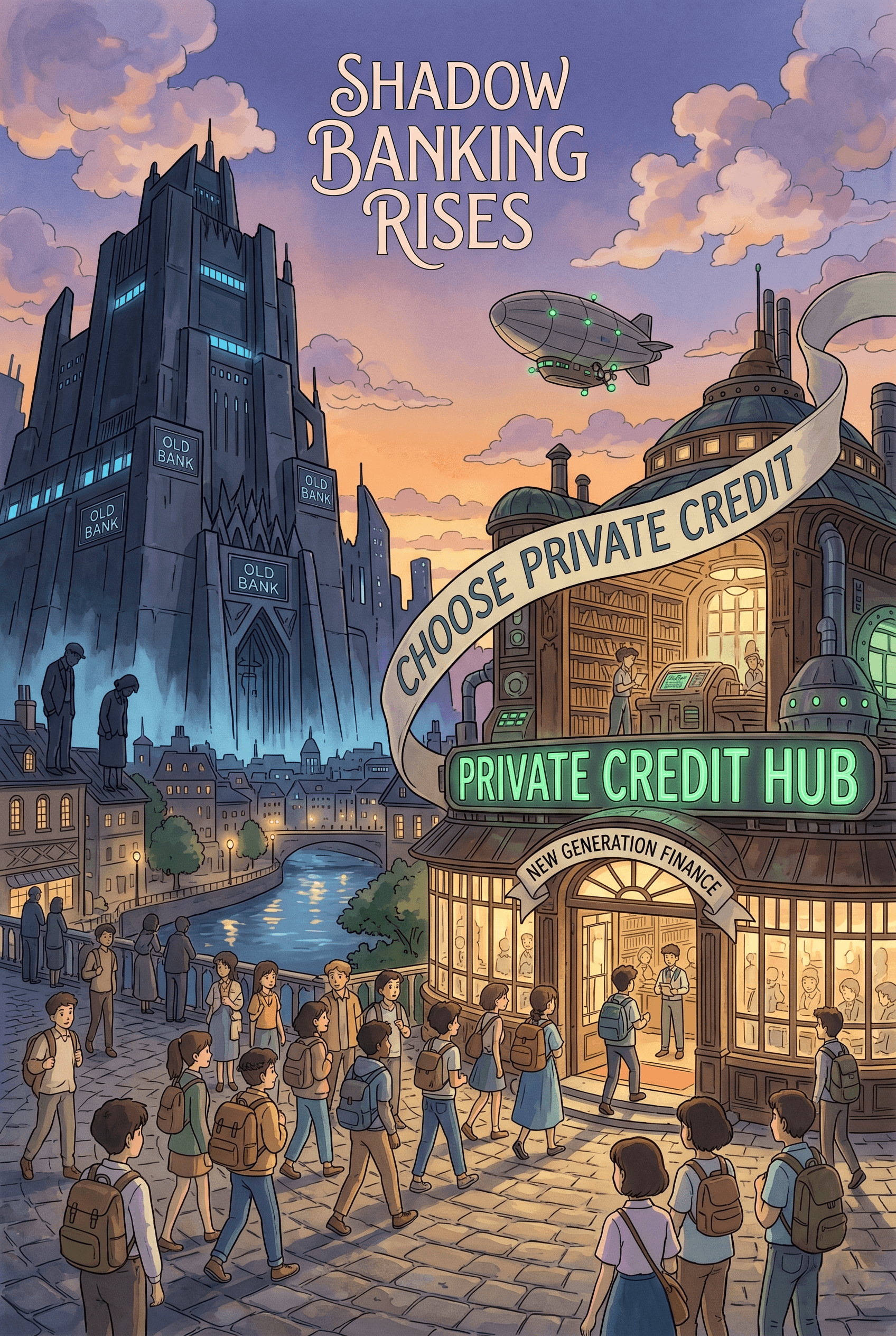
When Trust Leaves the System, Capital Follows
The shift did not happen overnight.
There was no single moment when people collectively decided to walk away from banks. No headline that marked the end of an era. Instead, it was quieter than that. Slower. Almost invisible.
Until suddenly, it wasn’t.
By 2026, the center of gravity in finance has moved—not through regulation, not through policy, but through behavior. Capital is no longer flowing through marble halls and institutional corridors. It is moving across tables, into funds, into private agreements where speed matters more than tradition and access matters more than structure.
This is the rise of private credit.
And it is not a niche anymore.
For decades, the act of borrowing money followed a familiar script. A company would approach a bank, submit documents, wait for approval, navigate layers of compliance, and eventually—if everything aligned—receive capital.
That script no longer fits the pace of the modern economy.
In its place, a different model has emerged. One where companies don’t apply—they negotiate. Where capital is not requested—it is structured. Where the relationship is not institutional—it is direct.
Private funds have stepped into the gap left by increasingly cautious banks. What began as an alternative channel for large corporations has expanded into something far more expansive. Mid-sized companies, growth-stage ventures, even infrastructure projects are now bypassing traditional banking systems entirely.
Not because they have to.
Because they prefer to.
The reasons are not purely financial.
They are psychological.
The generation now building companies and making capital decisions grew up in the aftermath of financial crises that reshaped their understanding of trust. The collapse of 2008, the instability of regional banks in the early 2020s—these events did not just affect markets. They rewired perception.
Banks, once seen as pillars, began to look rigid. Slow. Detached from the realities of how businesses actually operate.
Private credit, in contrast, feels different.
It listens.
It adapts.
It moves.
Where banks see risk through standardized frameworks, private funds see it through context. They evaluate not just balance sheets, but behavior, potential, trajectory. Deals are no longer forced into predefined structures. They are built around the specific needs of the borrower.
This flexibility is not a feature.
It is the product.
And so demand has followed.
In the United States and Europe, private credit has become the preferred route for mid-market companies seeking tens or hundreds of millions in financing. Not because banks are unavailable, but because they are inefficient.
Time, in this equation, is more valuable than cost.
Companies are willing to accept higher interest rates if it means immediate access to capital. Waiting months for approval in a traditional system is no longer compatible with markets that move in real time.
Further east, in Southeast Asia and India, the dynamic is even more pronounced. Entire sectors—especially technology and infrastructure—are being built on top of private financing channels. The growth is not incremental. It is exponential.
Capital is no longer centralized.
It is mobile.
But mobility comes with a trade-off.
Visibility.
The same qualities that make private credit attractive—its flexibility, its speed, its discretion—also make it difficult to track. Unlike traditional banks, these systems do not operate under the same level of scrutiny. They are not bound by the same reporting structures. They exist in a space that is partially visible, partially obscured.
This is where the term “shadow banking” begins to make sense.
Not because it is hidden in the sense of secrecy, but because it operates outside the light of traditional oversight.
And in that shadow, risk accumulates differently.
On the surface, the system appears resilient. Because it is not tied directly to the traditional banking framework, it is less exposed to classic failures like bank runs. Capital is distributed across funds, across deals, across networks that do not collapse in unison.
But beneath that surface, a different kind of fragility can form.
Debt that is not fully visible.
Exposure that is not fully understood.
Dependencies that only reveal themselves under stress.
If interest rates shift unexpectedly, if liquidity tightens, if confidence drops—the flexibility that once defined the system can turn into volatility.
And when that happens, the lack of transparency becomes a liability.
This is the paradox of the new financial order.
Private credit is solving real problems. It is accelerating access to capital, enabling growth, supporting businesses that would otherwise be constrained by outdated systems.
At the same time, it is creating a parallel structure—one that is less regulated, less visible, and potentially less stable under pressure.
The question, then, is not whether this system will continue to grow.
It will.
The question is what it becomes as it scales.
Because at its core, this is not just a financial shift.
It is a shift in where trust lives.
For generations, trust was institutional. It was placed in banks, in structures, in systems that were designed to outlast individuals.
Today, that trust is becoming transactional.
It is placed in relationships, in funds, in the ability of specific actors to deploy capital quickly and effectively.
Power is no longer held by those who store money.
It is held by those who move it.
And that changes everything.
Because as finance moves away from public systems and into private networks, access becomes more selective. Participation becomes more conditional. The system becomes faster—but also narrower.
What begins as democratization can quietly evolve into something else.
A new form of elitism.
Traditional banks are not disappearing.
But they are losing relevance.
Not because they failed, but because they could not adapt fast enough to a world that no longer waits.
And in that gap, something new has taken shape.
A system that is faster, more flexible, more aligned with the rhythm of modern markets.
But also one that operates in the shadows.
The rise of private credit is not the end of banking.
It is the beginning of something else.
Something less visible.
Less controlled.
And far more reflective of the world that created it.
Enjoyed this story?
More for you
Keep reading

Silicon, Cells, and Scarcity: The 2026 Financial Divergence of MU, DRAM, and PLUG
As global markets navigate the "gray zone" of post-pandemic debt management and shifting manufacturing hubs, the divergence between Micron’s semiconductor dominance and Plug Power’s hydrogen struggle represents the ultimate test of industrial survival.
Read moreFrom the feed
Latest Articles

WEB3
The Quiet Genesis: Why XEO is Refusing the Hype Cycle to Build a Sovereign Living Ecosystem
Aug 23, 2026· 2 min

CULTURE
The Bio-Digital Commons: Why Synthetic Biology Requires Decentralized Infrastructure
Jul 24, 2026· 6 min

CULTURE
The Shift Toward Abandoned Mining Shafts for Sovereign Data Center Architecture
Jun 30, 2026· 6 min

CULTURE
Premium Minimalist Hardware and the High-Stakes Economy of Digital Detargeting
Jun 24, 2026· 13 min

CULTURE
Licensing the Mind: The Economics of Generative Agents as High-Yield Digital Assets
Jun 23, 2026· 10 min

WEB3
The Sovereignty Deficit: Why Stablecoin Regulations in Emerging Markets are Forcing Capital Offshore
Jun 18, 2026· 4 min

WEB3
The Missing Piece in GameFi And How XEO Plans to Redefine Ownership, Utility, and Competitive Play
May 27, 2026· 3 min

CULTURE
Cognitive Sanctuary: E-Ink Monitors and the Aristocracy of Attention in the Age of Information Overload
May 22, 2026· 5 min

WEB3
Monero’s War on ASICs and the Structural Economics of Absolute Privacy
May 20, 2026· 10 min

WEB3
Top 10 Proof-of-Work Networks: Efficiency, Hardware Ecosystems, and Market Realities
May 18, 2026· 9 min
Briefs
Latest News

WEB3
XEO Ecosystem Releases Official Track "3.5 Billion Years" Produced by QuixTilt Records
Oct 1, 2026· 1 min

GLOBAL
Inside HSBC and the Bank of England’s Digital Securities Sandbox
Jul 25, 2026· 6 min
GLOBAL
Why S&P 500 Software is Lagging While AI Hardware Dominates 2026
Jul 25, 2026· 7 min

GLOBAL
Why Wall Street is Re-Valuing SpaceX as an AI Infrastructure Giant
Jul 25, 2026· 8 min
WEB3
S&P and Pantera’s Index Launch and the End of Speculative Token Valuation
Jul 22, 2026· 7 min

GLOBAL
The Algorithmic Border: How Kinetic Supply Chains are Reindexing South China Sea Logistics
Jul 10, 2026· 3 min

WEB3
A Vision Coming to Life: XEO Takes Strategic Steps to Shape the "Living Ecosystem" of the Future
Jul 8, 2026· 2 min

GLOBAL
The Screen Is No Longer Enough: Inside Silicon Valley’s Physical AI Pivot
May 19, 2026· 4 min

GLOBAL
Silicon Valley’s New Cold War: California vs. The White House Over AI Rules
May 19, 2026· 4 min

GLOBAL
Top 5 AI Processor Stocks to Watch in 2026
May 19, 2026· 4 min