The Relentless Resistance: Deciphering the May 2026 CPI Report
The May 2026 CPI report reveals an uncomfortable reality: headline inflation has surged to 3.89%, driven by energy spikes and a final wave of tariff pass-throughs, challenging the Federal Reserve's path toward a soft landing.
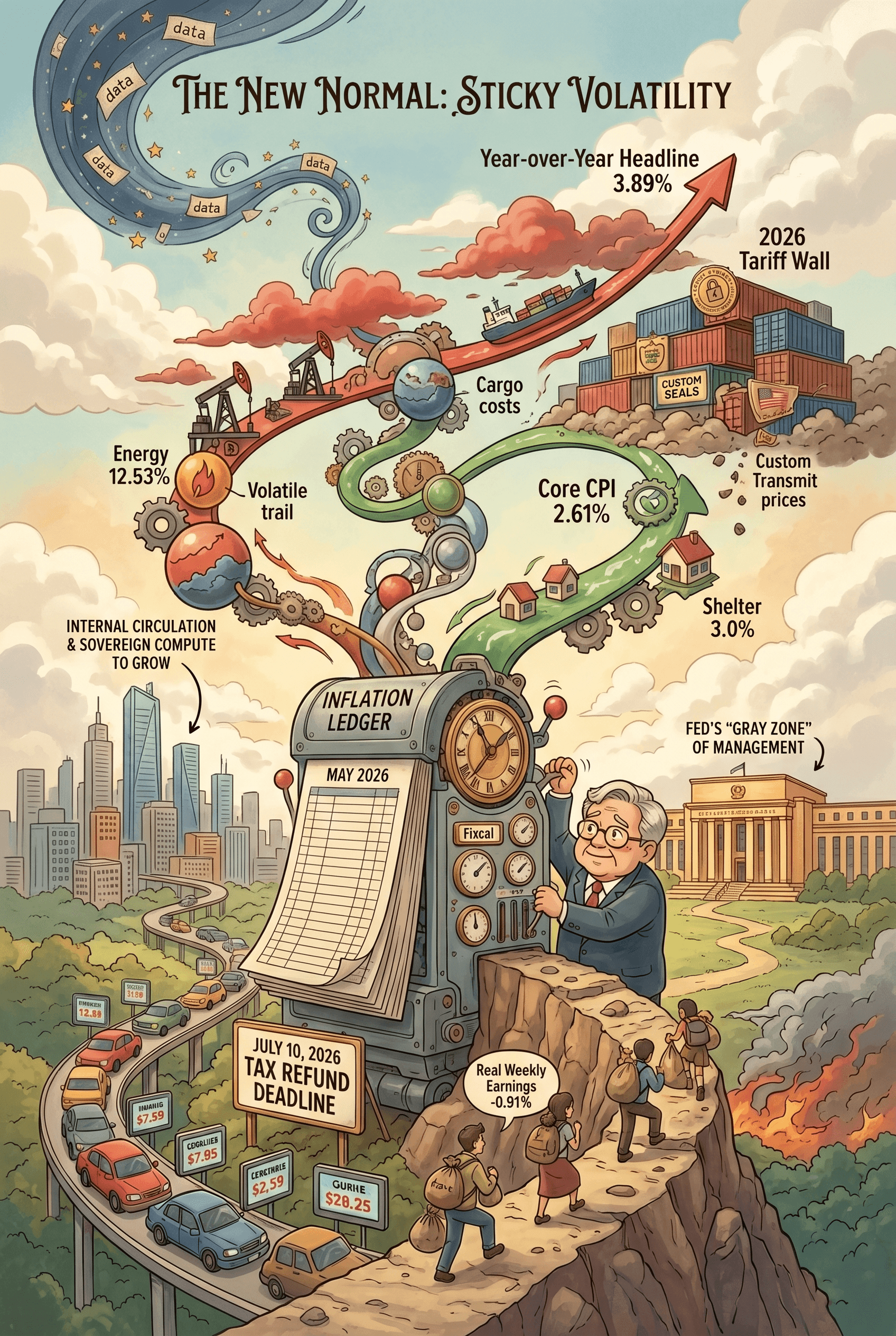
The Weight of the Ledger: A Mid-Year Inflation Reckoning
The release of the May 2026 Consumer Price Index (CPI) has sent a clear signal to global markets: the battle against inflation is entering a "sticky" and volatile new phase. For nearly two years, the narrative favored a gradual descent toward the Federal Reserve’s 2% target, but the latest data suggests a "Strategic Recalibration" is required. As of May 12, 2026, the year-over-year headline inflation has climbed to 3.89%, a notable acceleration from the 3.56% recorded in April.
This is no longer a simple post-pandemic correction. It is a complex interaction of energy volatility, a tighter labor market, and the finalized transmission of trade tariffs into the consumer basket. While the U.S. continues to manage the long-tail fiscal consequences of the early 2020s—including the final July 2026 deadline for pandemic-era tax relief—the broader economy is struggling to absorb new price pressures.
1. The Core vs. Headline Divergence
The May report highlights a widening gap between what consumers feel at the pump and the underlying "Core" inflationary pressures.
- Headline CPI: Rose to 3.89% year-over-year.
- Core CPI (Excluding Food & Energy): Remained more tempered at 2.61%.
- Monthly Momentum: The headline index increased 0.42% in May alone, following a 0.45% rise in April, indicating that price growth is not yet cooling on a month-to-month basis.
This divergence suggests that while "surgical" supply management has stabilized goods and services, external shocks—specifically in the energy sector—are keeping the national balance sheet under stress.
2. Energy and the "Tariff Transmission Lag"
The primary driver of the May spike is a resurgence in energy costs and the completed pass-through of import tariffs.
- Energy Spike: Energy price inflation hit 12.53% earlier this year, and May's data confirms that these costs are becoming "entrenched" in transportation and logistics.
- The 2026 Tariff Wall: Analysts have noted that while importers initially absorbed tariff costs, the first half of 2026 marked the point where these costs were fully passed to the consumer.
- Sector Specifics: Shelter remains a persistent floor for inflation, increasing 3.0% over the last year, while airline fares have seen a staggering 14.9% increase, reflecting both fuel costs and high demand for services.
3. The Federal Reserve’s "Gray Zone"
The Federal Reserve now operates in a disciplined "gray zone" of management. With a fiscal deficit exceeding 7% of GDP, the central government has become the "spender of last resort," making the Fed's job of cooling demand through high interest rates increasingly difficult.
- Liquidity Paradox: While the July 10, 2026, IRS refund deadline represents a critical injection of liquidity for households, this "found capital" may inadvertently fuel further spending in a high-inflation environment.
- Labor Realities: Real average weekly earnings decreased by 0.91% in the most recent quarterly check, suggesting that even as prices rise, the average consumer’s purchasing power is being eroded.
4. Macro Implications: Global and Sovereign Context
The U.S. inflation story in 2026 cannot be viewed in isolation. Much like China’s transition toward "Internal Circulation" and high-tech manufacturing to grow out of debt, the U.S. is betting on sovereign compute and energy transition to provide a structural growth floor.
Metric (May 2026 CPI) | Value |
Year-over-Year Headline CPI | 3.89% |
Year-over-Year Core CPI | 2.61% |
Shelter Index Growth | 3.0% |
Energy Index Increase | ~12.5% |
Real Weekly Earnings Change | -0.91% |
The era of passive expectation is over. For the retail investor and the American household, the May 2026 CPI report is a final "escape hatch" from the hope of a quick return to 2% inflation.
The economy is currently operating under a lapse in 2026 appropriations, yet the fundamental laws of supply and demand remain in full effect. Winners in this environment are not those betting on "generic stimulus," but those who understand the "Proof of Reality" etched in energy costs and high-tech infrastructure. If inflation exceeds 4% by year-end, as some forecasters warn, the "shotgun" approach to fiscal policy will be replaced by even stricter expenditure restraint.
Enjoyed this story?
More for you
Keep reading

The $0 Agency: How to Build a Local AI Business That Prints Money
A focused breakdown of how AI can be turned into a simple, repeatable local business model that generates real monthly income—without building a startup.
Read moreBriefs
Latest News

WEB3
XEO Ecosystem Releases Official Track "3.5 Billion Years" Produced by QuixTilt Records
Oct 1, 2026· 1 min

GLOBAL
Inside HSBC and the Bank of England’s Digital Securities Sandbox
Jul 25, 2026· 6 min

GLOBAL
Why S&P 500 Software is Lagging While AI Hardware Dominates 2026
Jul 25, 2026· 7 min

GLOBAL
Why Wall Street is Re-Valuing SpaceX as an AI Infrastructure Giant
Jul 25, 2026· 8 min

WEB3
S&P and Pantera’s Index Launch and the End of Speculative Token Valuation
Jul 22, 2026· 7 min

GLOBAL
The Algorithmic Border: How Kinetic Supply Chains are Reindexing South China Sea Logistics
Jul 10, 2026· 3 min

WEB3
A Vision Coming to Life: XEO Takes Strategic Steps to Shape the "Living Ecosystem" of the Future
Jul 8, 2026· 2 min

GLOBAL
The Screen Is No Longer Enough: Inside Silicon Valley’s Physical AI Pivot
May 19, 2026· 4 min

GLOBAL
Silicon Valley’s New Cold War: California vs. The White House Over AI Rules
May 19, 2026· 4 min

GLOBAL
Top 5 AI Processor Stocks to Watch in 2026
May 19, 2026· 4 min
From the feed
Latest Articles

WEB3
The Quiet Genesis: Why XEO is Refusing the Hype Cycle to Build a Sovereign Living Ecosystem
Aug 23, 2026· 2 min

CULTURE
The Bio-Digital Commons: Why Synthetic Biology Requires Decentralized Infrastructure
Jul 24, 2026· 6 min

CULTURE
The Shift Toward Abandoned Mining Shafts for Sovereign Data Center Architecture
Jun 30, 2026· 6 min

CULTURE
Premium Minimalist Hardware and the High-Stakes Economy of Digital Detargeting
Jun 24, 2026· 13 min

CULTURE
Licensing the Mind: The Economics of Generative Agents as High-Yield Digital Assets
Jun 23, 2026· 10 min

WEB3
The Sovereignty Deficit: Why Stablecoin Regulations in Emerging Markets are Forcing Capital Offshore
Jun 18, 2026· 4 min

WEB3
The Missing Piece in GameFi And How XEO Plans to Redefine Ownership, Utility, and Competitive Play
May 27, 2026· 3 min

CULTURE
Cognitive Sanctuary: E-Ink Monitors and the Aristocracy of Attention in the Age of Information Overload
May 22, 2026· 5 min

WEB3
Monero’s War on ASICs and the Structural Economics of Absolute Privacy
May 20, 2026· 10 min

WEB3
Top 10 Proof-of-Work Networks: Efficiency, Hardware Ecosystems, and Market Realities
May 18, 2026· 9 min