The AI Bubble, Data Wars, and the Cost of Infrastructure: Why 2026 Feels Bigger Than the Dot-Com Era
From Nasdaq’s explosive AI rally to Nvidia’s billion-dollar investments and geopolitical shipping tensions, this week’s biggest stories reveal that the modern economy is no longer built on products—but on infrastructure itself.
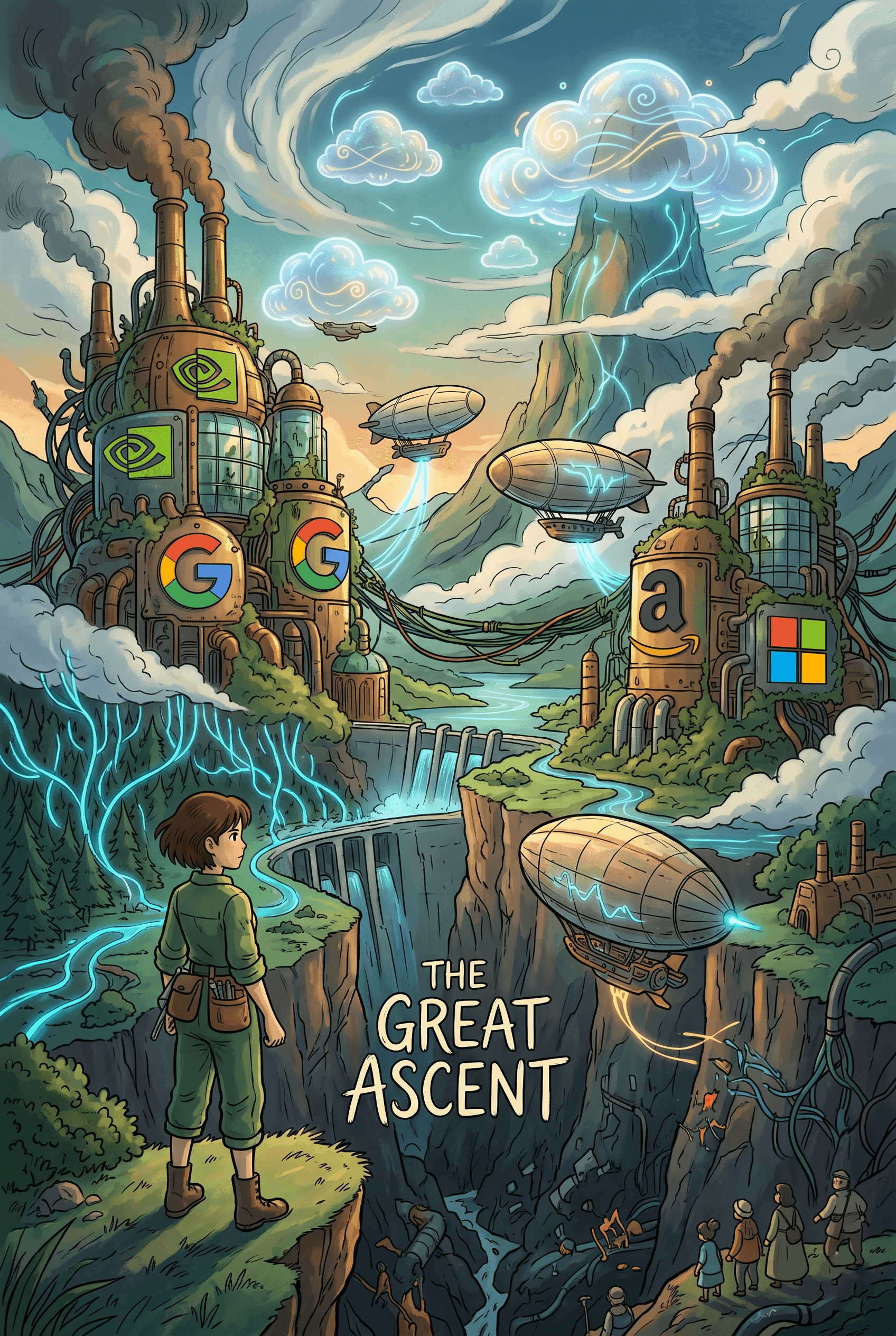
This week’s headlines looked disconnected at first.
Nasdaq’s top-performing stocks reportedly surpassed the explosive momentum of the dot-com era. Nvidia committed tens of billions into AI-related equity deals. Wall Street continued debating AI-linked job losses. Qatar attempted another LNG shipment route through Hormuz amid rising geopolitical pressure. Meanwhile, companies ranging from GM to major cloud and semiconductor players faced growing legal, regulatory, and operational scrutiny tied to data infrastructure itself.
But underneath the noise, all these stories are converging toward the same reality:
The global economy is no longer centered around products.
It is centered around infrastructure.
And the new infrastructure is intelligence, energy, semiconductors, logistics, and data.
The comparison to the year 2000 is not accidental. During the dot-com bubble, markets were fueled by belief in the internet’s future potential. Today’s AI rally operates differently. The internet already won. AI is now being built on top of an already fully digitized civilization.
That changes the scale completely.
In 2000, companies were promising digital transformation. In 2026, AI systems are directly restructuring labor markets, software development, logistics, customer service, education, finance, and media production in real time.
This is not speculation about a future internet.
This is a battle over who controls the operating system of modern civilization.
That is why Nvidia’s aggressive capital deployment matters far beyond stock performance alone. The company is no longer simply selling GPUs. It is becoming foundational infrastructure for the AI economy itself. Semiconductor dominance increasingly resembles oil dominance during the industrial era.
The nations and corporations controlling compute infrastructure may ultimately shape the next century of economic power.
But infrastructure booms always create secondary pressure points.
Energy demand rises.
Cooling demand rises.
Shipping dependency rises.
Geopolitical leverage rises.
That is why headlines about LNG shipping routes through Hormuz suddenly belong in the same conversation as AI markets.
Artificial intelligence is not “virtual” infrastructure.
It is physical infrastructure disguised as software.
Every large language model, recommendation engine, autonomous system, and AI-generated workflow ultimately depends on electricity grids, subsea cables, semiconductor fabrication plants, mineral supply chains, and global shipping routes.
The AI economy consumes reality at industrial scale.
At the same time, markets are beginning to show signs of psychological overheating. Comparisons between today’s Nasdaq winners and the dot-com bubble reveal growing investor awareness that optimism itself may be accelerating faster than underlying economic stability.
But unlike 2000, the danger today is more complicated.
The dot-com era largely inflated digital expectations.
The AI era may inflate civilization-scale dependency.
That distinction matters.
When speculative internet companies collapsed in the early 2000s, society did not structurally depend on them for daily operations. Today, however, cloud systems, AI infrastructure, digital logistics, algorithmic finance, and automated communication systems are deeply integrated into modern civilization itself.
The system cannot simply “log off” anymore.
Meanwhile, discussions around AI-linked layoffs reveal another growing tension beneath the surface. Wall Street increasingly treats workforce reduction as proof of technological efficiency. But the deeper issue is not whether AI replaces jobs—it is whether economic systems can adapt fast enough to a world where intelligence itself becomes automated infrastructure.
For decades, automation primarily replaced physical labor.
AI targets cognitive labor.
That transition could reshape the global middle class more aggressively than previous industrial revolutions.
And yet despite all the fear surrounding AI, the real story may actually be concentration.
A small number of corporations increasingly control:
- compute
- cloud infrastructure
- semiconductor production
- recommendation systems
- AI model access
- digital identity ecosystems
The internet originally promised decentralization.
Instead, it gradually evolved into hyperscale concentration.
Now the AI era risks accelerating that concentration even further.
This is why infrastructure—not applications—may become the defining economic battleground of the next decade.
Not the smartest chatbot.
Not the most viral app.
Not the most entertaining platform.
But the companies, nations, and systems controlling the invisible layers beneath them.
Because history repeatedly shows the same pattern:
The entities controlling the routes eventually control the world.
And in 2026, the new routes are made of data, energy, semiconductors, and intelligence.
Enjoyed this story?
More for you
Keep reading

Google’s Ecosystem Shift and Sony’s Supply Chain Dilemma
As Google unifies its Android and ChromeOS platforms under "Aluminium OS" to establish a new category of AI-driven laptops, Sony re-evaluates its timeline for the PlayStation 6 due to ongoing global supply chain constraints.
Read moreBriefs
Latest News

WEB3
XEO Ecosystem Releases Official Track "3.5 Billion Years" Produced by QuixTilt Records
Oct 1, 2026· 1 min

GLOBAL
Inside HSBC and the Bank of England’s Digital Securities Sandbox
Jul 25, 2026· 6 min
GLOBAL
Why S&P 500 Software is Lagging While AI Hardware Dominates 2026
Jul 25, 2026· 7 min

GLOBAL
Why Wall Street is Re-Valuing SpaceX as an AI Infrastructure Giant
Jul 25, 2026· 8 min
WEB3
S&P and Pantera’s Index Launch and the End of Speculative Token Valuation
Jul 22, 2026· 7 min

GLOBAL
The Algorithmic Border: How Kinetic Supply Chains are Reindexing South China Sea Logistics
Jul 10, 2026· 3 min

WEB3
A Vision Coming to Life: XEO Takes Strategic Steps to Shape the "Living Ecosystem" of the Future
Jul 8, 2026· 2 min

GLOBAL
The Screen Is No Longer Enough: Inside Silicon Valley’s Physical AI Pivot
May 19, 2026· 4 min

GLOBAL
Silicon Valley’s New Cold War: California vs. The White House Over AI Rules
May 19, 2026· 4 min

GLOBAL
Top 5 AI Processor Stocks to Watch in 2026
May 19, 2026· 4 min
From the feed
Latest Articles

WEB3
The Quiet Genesis: Why XEO is Refusing the Hype Cycle to Build a Sovereign Living Ecosystem
Aug 23, 2026· 2 min

CULTURE
The Bio-Digital Commons: Why Synthetic Biology Requires Decentralized Infrastructure
Jul 24, 2026· 6 min

CULTURE
The Shift Toward Abandoned Mining Shafts for Sovereign Data Center Architecture
Jun 30, 2026· 6 min

CULTURE
Premium Minimalist Hardware and the High-Stakes Economy of Digital Detargeting
Jun 24, 2026· 13 min

CULTURE
Licensing the Mind: The Economics of Generative Agents as High-Yield Digital Assets
Jun 23, 2026· 10 min

WEB3
The Sovereignty Deficit: Why Stablecoin Regulations in Emerging Markets are Forcing Capital Offshore
Jun 18, 2026· 4 min

WEB3
The Missing Piece in GameFi And How XEO Plans to Redefine Ownership, Utility, and Competitive Play
May 27, 2026· 3 min

CULTURE
Cognitive Sanctuary: E-Ink Monitors and the Aristocracy of Attention in the Age of Information Overload
May 22, 2026· 5 min

WEB3
Monero’s War on ASICs and the Structural Economics of Absolute Privacy
May 20, 2026· 10 min

WEB3
Top 10 Proof-of-Work Networks: Efficiency, Hardware Ecosystems, and Market Realities
May 18, 2026· 9 min