Code vs. Constitution: The 2026 Global Power Struggle Over Smart Contract Legality
Smart contracts are rewriting ownership and finance—but can code replace law? The 2026 legal battle between automation and human judgment is just beginning.
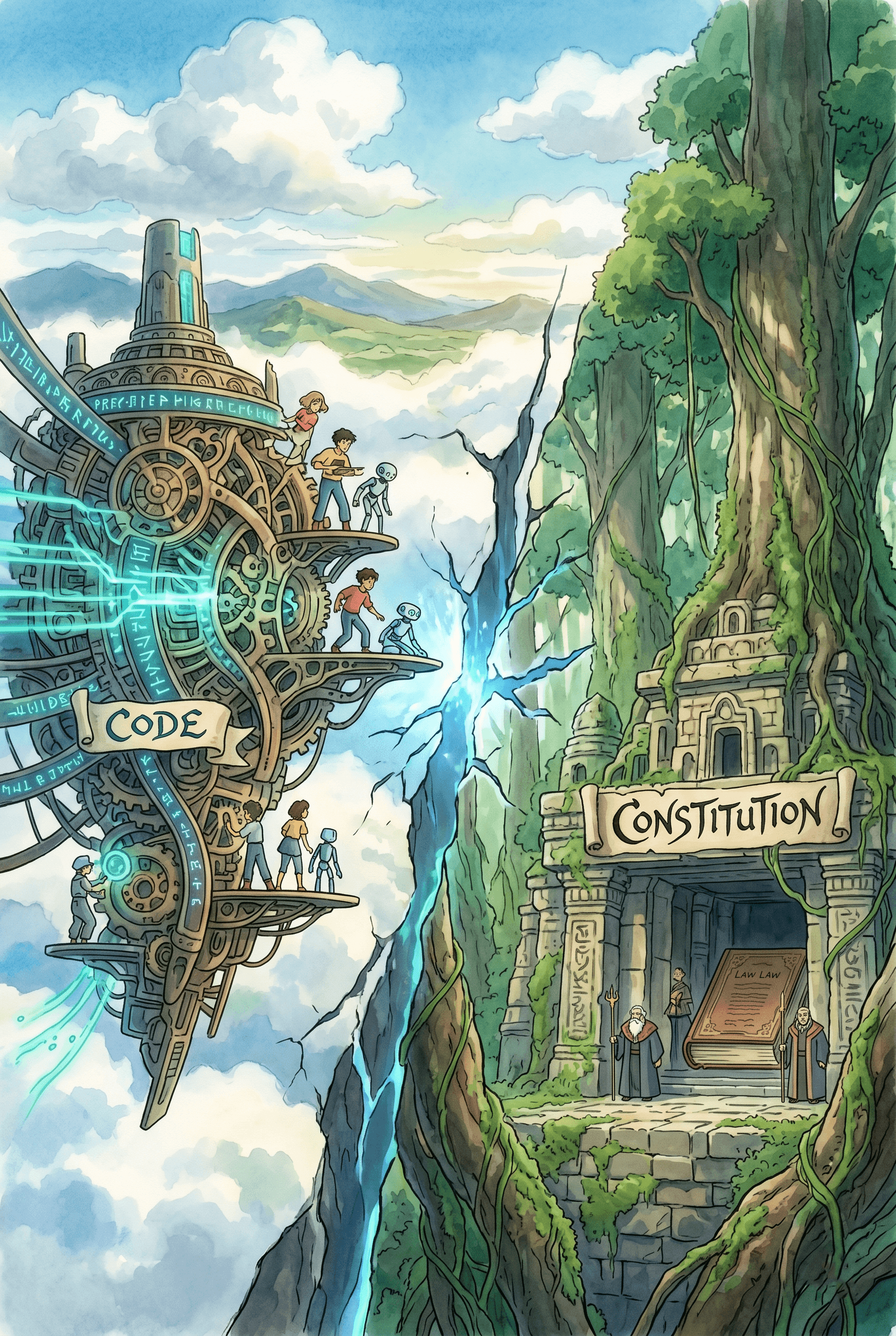
When Mathematics Meets Judgment
There was a time when law lived in books.
Heavy, static, interpretive. It required people to read it, understand it, argue over it. It was slow, human, and imperfect—but it was also flexible. It could bend, reinterpret, and correct itself.
Code does not bend.
And that is exactly why it became powerful.
In 2026, the conflict between code and constitution is no longer theoretical.
It is operational.
Smart contracts are no longer experiments running on the edge of finance. They are executing transactions, distributing capital, transferring ownership, and—most importantly—removing interpretation from systems that were built on it.
This is where the fracture begins.
Because law is built on intention.
Code is built on execution.
The emergence of the “reasonable coder” doctrine marks the first serious attempt to bridge that gap.
Courts in jurisdictions like the United Kingdom and Singapore have started to treat smart contracts not as agreements between people, but as artifacts of logic. In disputes, the question is no longer “what did the parties mean?” but “what should a competent programmer understand from this code?”
This is a radical shift.
It moves legal interpretation away from human language and toward technical literacy. It assumes that code itself is a form of communication—precise, deterministic, but not immune to misunderstanding.
And then came the first real test.
In London, a trader exploited a vulnerability in a DeFi protocol and defended himself with a simple argument: the system allowed it. The contract executed exactly as written. There was no breach—only execution.
The court did not fully reject this logic.
But it did not accept it either.
The ruling introduced a subtle but powerful boundary: code can define what is possible, but it does not automatically define what is fair. The concept of unjust enrichment still applies, even in a system where everything is technically valid.
That decision did not break the idea of “code is law.”
It weakened its absolutism.
Developed economies have taken this signal seriously.
Their approach is not to reject smart contracts, but to contain them.
The European Union’s regulatory framework, evolving through initiatives like the Data Act, reflects a philosophy of controlled automation. Systems are allowed to run autonomously—but not irreversibly.
The introduction of mandatory “kill switches” is one of the clearest examples of this mindset.
Every major smart contract operating within regulated environments must now include a mechanism that allows intervention. Not by developers alone, but by legal authority.
This changes everything.
Because immutability was never just a feature.
It was a belief.
And that belief is now being negotiated.
Other jurisdictions follow a similar pattern.
In places like Dubai and Switzerland, smart contracts are expected to pass rigorous audits before deployment. Security, transparency, and compliance are not optional—they are prerequisites for legitimacy.
For these systems, code is not sovereign.
It is subordinate.
But this is not a global consensus.
In developing regions, the same technology is being used very differently.
Not to reinforce existing systems, but to bypass them.
In countries where bureaucracy is slow, opaque, or vulnerable to corruption, smart contracts are not seen as risky.
They are seen as liberating.
El Salvador’s experiments with blockchain-based registries reflect a broader attempt to rebuild trust from the ground up. Instead of relying on institutions that may fail, the system is designed so that execution itself becomes the guarantee.
Ownership is not recorded.
It is enacted.
In parts of Africa, similar logic is being applied to logistics and trade.
By embedding contracts directly into transaction flows, opportunities for manipulation shrink. Bribery becomes harder when processes are automated. Delays become visible when execution is transparent.
In these environments, code is not competing with law.
It is replacing its weakest parts.
This creates a divergence.
Developed systems move cautiously, layering safeguards on top of automation.
Developing systems move aggressively, using automation to escape structural limitations.
One side builds control.
The other builds momentum.
And somewhere in between, the idea of a hybrid system begins to form.
By the end of 2026, the phrase “code is law” no longer carries the same weight it once did.
It has evolved.
Into something more realistic, but also more complex:
Law exists within code.
This is not a surrender of authority.
It is a redistribution.
Legal systems are beginning to embed themselves into technical frameworks, while technical systems are forced to acknowledge human oversight. Neither side fully dominates.
They coexist.
Uneasily.
Because at its core, this is not a technical conflict.
It is a philosophical one.
Do we trust systems that cannot change, or systems that can be corrected?
Do we prefer perfect execution, or imperfect judgment?
Code offers certainty.
But it cannot forgive.
Law offers interpretation.
But it cannot guarantee consistency.
And this is the tension that defines 2026.
A world where property, capital, and rights are increasingly managed by systems that execute without hesitation—yet still exist within societies that demand fairness, context, and correction.
The future will not belong entirely to code.
Nor will it remain in the hands of traditional institutions.
It will belong to the space where both intersect.
Because in the end, no system is fully autonomous.
Not even one built on mathematics.
There is always a human behind the code.
And sometimes, there must be a human above it.
Enjoyed this story?
More for you
Keep reading

The Test of Solana’s Brand Loyalty: Culture and Reality in a Bear Market
Solana built an unshakable bond through its community-driven ecosystem and the cultural power of its "Discord Kingdom" era. But with a macro downturn looming, will this emotional connection be enough to shield SOL on its path toward $38.50?
Read moreFrom the feed
Latest Articles

WEB3
The Quiet Genesis: Why XEO is Refusing the Hype Cycle to Build a Sovereign Living Ecosystem
Aug 23, 2026· 2 min

CULTURE
The Bio-Digital Commons: Why Synthetic Biology Requires Decentralized Infrastructure
Jul 24, 2026· 6 min

CULTURE
The Shift Toward Abandoned Mining Shafts for Sovereign Data Center Architecture
Jun 30, 2026· 6 min

CULTURE
Premium Minimalist Hardware and the High-Stakes Economy of Digital Detargeting
Jun 24, 2026· 13 min

CULTURE
Licensing the Mind: The Economics of Generative Agents as High-Yield Digital Assets
Jun 23, 2026· 10 min

WEB3
The Sovereignty Deficit: Why Stablecoin Regulations in Emerging Markets are Forcing Capital Offshore
Jun 18, 2026· 4 min

WEB3
The Missing Piece in GameFi And How XEO Plans to Redefine Ownership, Utility, and Competitive Play
May 27, 2026· 3 min

CULTURE
Cognitive Sanctuary: E-Ink Monitors and the Aristocracy of Attention in the Age of Information Overload
May 22, 2026· 5 min

WEB3
Monero’s War on ASICs and the Structural Economics of Absolute Privacy
May 20, 2026· 10 min

WEB3
Top 10 Proof-of-Work Networks: Efficiency, Hardware Ecosystems, and Market Realities
May 18, 2026· 9 min
Briefs
Latest News

WEB3
XEO Ecosystem Releases Official Track "3.5 Billion Years" Produced by QuixTilt Records
Oct 1, 2026· 1 min

GLOBAL
Inside HSBC and the Bank of England’s Digital Securities Sandbox
Jul 25, 2026· 6 min
GLOBAL
Why S&P 500 Software is Lagging While AI Hardware Dominates 2026
Jul 25, 2026· 7 min

GLOBAL
Why Wall Street is Re-Valuing SpaceX as an AI Infrastructure Giant
Jul 25, 2026· 8 min
WEB3
S&P and Pantera’s Index Launch and the End of Speculative Token Valuation
Jul 22, 2026· 7 min

GLOBAL
The Algorithmic Border: How Kinetic Supply Chains are Reindexing South China Sea Logistics
Jul 10, 2026· 3 min

WEB3
A Vision Coming to Life: XEO Takes Strategic Steps to Shape the "Living Ecosystem" of the Future
Jul 8, 2026· 2 min

GLOBAL
The Screen Is No Longer Enough: Inside Silicon Valley’s Physical AI Pivot
May 19, 2026· 4 min

GLOBAL
Silicon Valley’s New Cold War: California vs. The White House Over AI Rules
May 19, 2026· 4 min

GLOBAL
Top 5 AI Processor Stocks to Watch in 2026
May 19, 2026· 4 min