The New American Dream: How People Are Making Passive Income with AI in Texas, Wyoming, and Rural America
From Texas to rural America, individuals are using AI to build passive income streams that operate with minimal daily effort. Here’s what’s really happening.
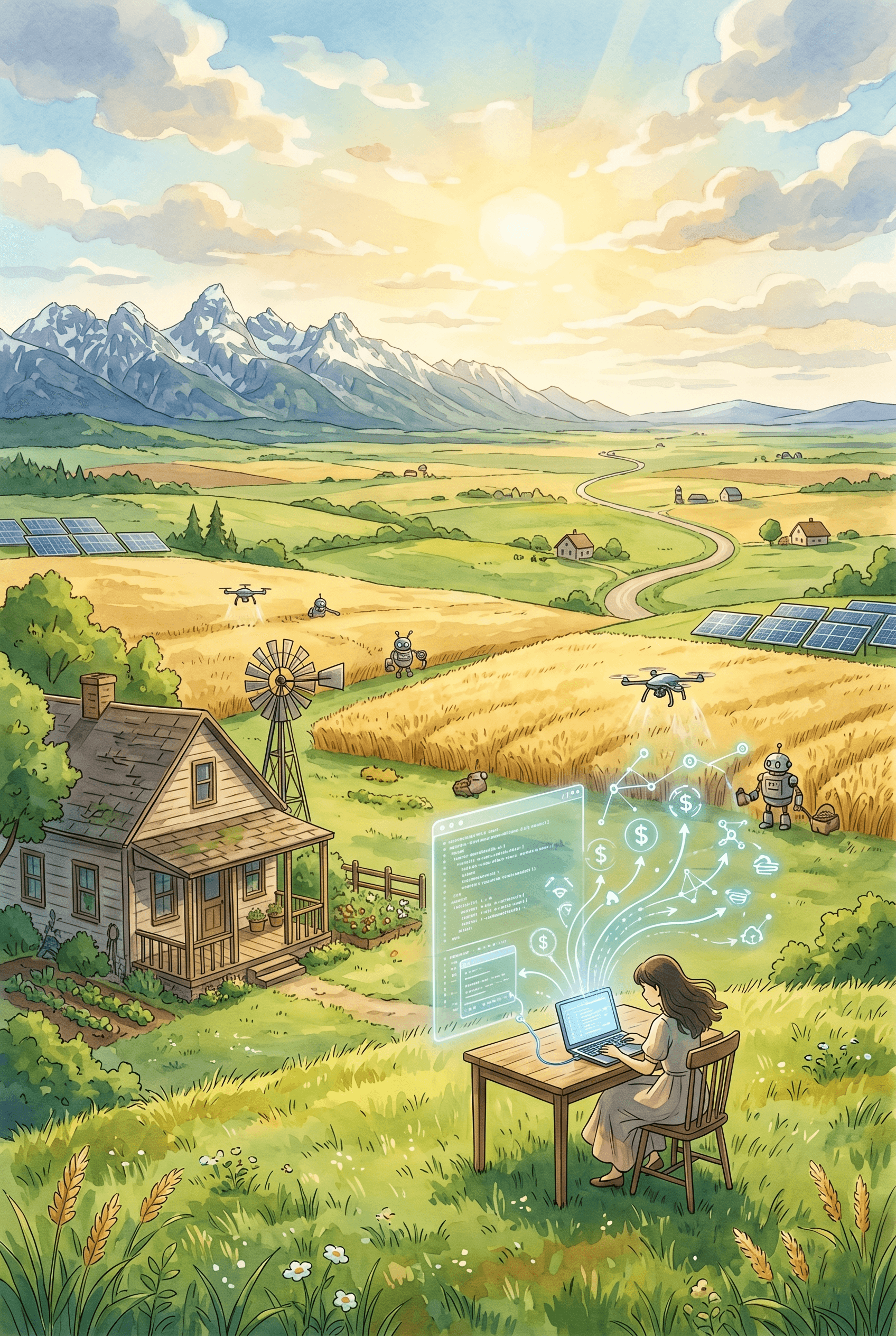
A quiet shift is unfolding across the United States—where income is no longer tied to location, and in some places, not even to active work.
For generations, the American Dream was built on a simple formula: work hard, earn steadily, and over time, build stability. Income was directly tied to effort. Time in meant money out.
That equation is starting to break.
Not everywhere, and not all at once. But in specific parts of the United States, a different model is quietly taking shape—one where income is increasingly detached from both geography and daily labor.
It’s not replacing traditional work.
But it’s running alongside it.
And in some cases, outperforming it.
In Texas, particularly in cities like Austin and Dallas, a new class of independent operators has emerged. These aren’t Silicon Valley founders or venture-backed startups. They’re individuals—sometimes solo, sometimes in small teams—building automated income streams powered by AI tools.
The mechanics are surprisingly simple.
An individual identifies a niche—local services, content generation, digital products, lead generation—and builds a system around it. AI tools, many of them powered by platforms from OpenAI and integrated through services offered by Amazon, are used to generate content, respond to inquiries, optimize listings, and even handle customer communication.
Once set up, these systems require minimal daily involvement.
A local lead-generation site for roofing services.
An automated content network monetized through ads.
A digital product storefront with AI-generated assets.
None of these are entirely passive at the beginning. But once operational, they begin to resemble something closer to infrastructure than labor.
“This isn’t a job. It’s a system that keeps working after you stop.”
The real shift isn’t just technological—it’s psychological.
People are no longer asking, “What job should I get?”
They’re asking, “What system can I build?”
Move north to Wyoming, and the pattern evolves.
Wyoming has positioned itself as one of the most digital-asset-friendly states in the U.S., passing legislation that recognizes blockchain-based entities and creates legal frameworks for decentralized operations. While originally aimed at crypto innovation, this environment has unintentionally supported a broader category of AI-driven and automation-based income models.
Here, the emphasis isn’t just on building systems—it’s on owning them.
Individuals are structuring digital businesses, holding assets in tokenized or automated formats, and experimenting with new forms of ownership that blur the line between software and enterprise.
This isn’t mainstream yet.
But it’s growing quietly.
Then there’s rural America—places that were never considered part of the tech economy.
States like South Dakota offer a different kind of advantage. Lower living costs, fewer economic pressures, and a slower pace of life create an environment where even modest digital income streams can have an outsized impact.
A system generating $2,000 to $5,000 per month might be insignificant in San Francisco.
In rural regions, it can replace a full-time job.
This is where the model becomes more visible.
Individuals are running AI-assisted e-commerce stores, managing niche affiliate sites, or operating automated service funnels—all from locations that have little to no connection to traditional tech hubs.
The infrastructure is entirely digital.
The location is almost irrelevant.
“AI didn’t just create new tools. It removed geography from the equation.”
This decoupling of income from location is one of the most important economic shifts currently underway.
Historically, opportunity was concentrated in cities. Access to jobs, networks, and capital required physical presence. Today, a growing number of income-generating systems can be built and operated from anywhere with a stable internet connection.
The implications are significant.
It means that economic participation is no longer strictly tied to where you live—but to what you can build.
Of course, this doesn’t mean that passive income is easy or guaranteed.
The early phase still requires effort—often significant effort. Building a system that generates consistent revenue involves experimentation, failure, and iteration. Many attempts do not succeed.
But the difference lies in the nature of the work.
Instead of trading time for money, individuals are investing time into creating something that can operate independently.
This shift is also reflected in the rise of what’s often called “AI side hustles.”
Across the U.S., thousands of individuals are building small-scale systems:
- AI-generated newsletters monetized through subscriptions
- Automated YouTube channels with outsourced editing and AI scripting
- Niche websites ranking on search engines using AI-assisted content
- Digital products created and sold with minimal human intervention
These are not hypothetical models.
They are operational.
And in many cases, they are profitable.
What makes this moment different from previous “side hustle” waves is the level of automation.
In the past, scaling required hiring people. Today, scaling often means improving systems.
AI handles the repetitive tasks.
Automation handles the workflows.
The individual focuses on strategy.
This creates a new kind of leverage.
One person, supported by the right tools, can produce the output of a small team.
But there’s a second layer to this shift—one that is less discussed.
Not everyone is benefiting equally.
The individuals succeeding in this space tend to share certain characteristics: digital literacy, access to tools, and the ability to navigate uncertainty. For those without these advantages, the barrier to entry can still be high.
This creates a divergence.
On one side, a growing group of individuals building income systems that operate independently of time and location.
On the other, a workforce still tied to traditional employment structures that are slowly being reshaped by the same technologies.
“AI is not just creating new opportunities. It is redistributing who can access them.”
This is where the idea of the “new American Dream” begins to take shape.
It’s no longer defined solely by employment, but by ownership—of systems, of processes, of digital assets that generate value over time.
It’s less about climbing a ladder.
More about building something that runs on its own.
And importantly, it’s not limited to major cities or tech hubs.
It’s emerging in Texas.
It’s taking root in Wyoming.
It’s spreading quietly across rural America.
Not as a replacement for traditional work—but as an alternative path.
Whether this model becomes dominant or remains a parallel system is still unclear.
But one thing is certain:
The relationship between work, income, and location is changing.
And for the first time in decades, the starting point of that change isn’t a corporation.
It’s the individual.
Enjoyed this story?
More for you
Keep reading

Premium Minimalist Hardware and the High-Stakes Economy of Digital Detargeting
As behavioral capitalism turns human attention into a highly optimized extraction asset, a new class of premium minimalist hardware is shifting from a counter-culture experiment into a vital defense system for cognitive autonomy.
Read moreFrom the feed
Latest Articles
WEB3
The Quiet Genesis: Why XEO is Refusing the Hype Cycle to Build a Sovereign Living Ecosystem
Aug 23, 2026· 2 min

CULTURE
The Bio-Digital Commons: Why Synthetic Biology Requires Decentralized Infrastructure
Jul 24, 2026· 6 min

CULTURE
The Shift Toward Abandoned Mining Shafts for Sovereign Data Center Architecture
Jun 30, 2026· 6 min
CULTURE
Premium Minimalist Hardware and the High-Stakes Economy of Digital Detargeting
Jun 24, 2026· 13 min

CULTURE
Licensing the Mind: The Economics of Generative Agents as High-Yield Digital Assets
Jun 23, 2026· 10 min

WEB3
The Sovereignty Deficit: Why Stablecoin Regulations in Emerging Markets are Forcing Capital Offshore
Jun 18, 2026· 4 min

WEB3
The Missing Piece in GameFi And How XEO Plans to Redefine Ownership, Utility, and Competitive Play
May 27, 2026· 3 min

CULTURE
Cognitive Sanctuary: E-Ink Monitors and the Aristocracy of Attention in the Age of Information Overload
May 22, 2026· 5 min

WEB3
Monero’s War on ASICs and the Structural Economics of Absolute Privacy
May 20, 2026· 10 min

WEB3
Top 10 Proof-of-Work Networks: Efficiency, Hardware Ecosystems, and Market Realities
May 18, 2026· 9 min
Briefs
Latest News

WEB3
XEO Ecosystem Releases Official Track "3.5 Billion Years" Produced by QuixTilt Records
Oct 1, 2026· 1 min

GLOBAL
Inside HSBC and the Bank of England’s Digital Securities Sandbox
Jul 25, 2026· 6 min
GLOBAL
Why S&P 500 Software is Lagging While AI Hardware Dominates 2026
Jul 25, 2026· 7 min

GLOBAL
Why Wall Street is Re-Valuing SpaceX as an AI Infrastructure Giant
Jul 25, 2026· 8 min
WEB3
S&P and Pantera’s Index Launch and the End of Speculative Token Valuation
Jul 22, 2026· 7 min

GLOBAL
The Algorithmic Border: How Kinetic Supply Chains are Reindexing South China Sea Logistics
Jul 10, 2026· 3 min

WEB3
A Vision Coming to Life: XEO Takes Strategic Steps to Shape the "Living Ecosystem" of the Future
Jul 8, 2026· 2 min

GLOBAL
The Screen Is No Longer Enough: Inside Silicon Valley’s Physical AI Pivot
May 19, 2026· 4 min

GLOBAL
Silicon Valley’s New Cold War: California vs. The White House Over AI Rules
May 19, 2026· 4 min
GLOBAL
Top 5 AI Processor Stocks to Watch in 2026
May 19, 2026· 4 min