The AI Power Race: Who Builds the Future—and Can Anyone Beat the Giants?
Explore the AI industry’s power structure, success rates, and what it takes to challenge giants like NVIDIA and OpenAI.

Artificial intelligence is no longer a speculative field—it has become a concentrated arena of power where infrastructure, capital, and talent define the limits of possibility. What appears, from the outside, as a rapidly expanding ecosystem is in reality tightly structured, with only a small number of organizations capable of operating at the highest level.
At the center of this structure sit a handful of frontier developers such as OpenAI, Google DeepMind, Anthropic, Meta, Microsoft, and Amazon. These companies do not merely build models—they operate entire ecosystems where research, infrastructure, and distribution are vertically integrated. Around them exists a second layer of ambitious challengers like Mistral AI, Cohere, and Stability AI, each attempting to carve out space in a landscape already shaped by giants. Beyond that, thousands of startups compete at the edges, but very few possess the necessary density of compute, talent, and capital to move the frontier itself.
The illusion of accessibility is largely driven by capital. Billions of dollars have flowed into AI since 2020, yet funding alone rarely translates into durable success. Most AI startups fail or plateau within a few years, and even among heavily funded companies, only a small minority reach sustainable profitability. The pattern is consistent: early hype attracts capital, but long-term survival depends on infrastructure access, distribution channels, and the ability to continuously reinvest at scale.
What makes this industry uniquely difficult is not any single barrier, but the convergence of several. Compute sits at the foundation, dominated by companies like NVIDIA, whose GPUs power the majority of modern AI systems. Training frontier models requires tens of thousands of these chips, translating into costs that can exceed hundreds of millions of dollars annually. This creates a structural dependency that is extremely difficult to bypass.
Talent is equally scarce. The number of researchers capable of pushing the boundaries of large-scale AI is limited, and competition for them is global and relentless. Compensation packages routinely reach into seven figures, but even that does not guarantee retention. At the same time, proprietary data has become a strategic asset. Models are only as powerful as the data they are trained on, and access to high-quality, legally usable datasets is increasingly restricted.
Even with cutting-edge models, success ultimately depends on distribution. This is where the largest technology companies reinforce their dominance. Microsoft embeds AI across its software ecosystem, Google integrates it into search and Android, and Amazon leverages its cloud infrastructure to control access. In this environment, platforms—not just models—determine who wins.
To reach the level of a true AI giant, technical excellence is not enough. What defines these companies is system-level control: infrastructure, distribution, and data operating as a unified loop. The result is a form of ecosystem lock-in where users, developers, and businesses become increasingly dependent on a single stack. Over time, this creates powerful network effects—more usage generates more data, which improves models, which attracts more users.
Within this system, NVIDIA occupies a uniquely critical position. It is not just a hardware provider; it is the backbone of the entire AI supply chain. Its CUDA ecosystem, deep integration with frameworks, and decades of optimization have created a level of lock-in that competitors struggle to challenge. Companies like AMD and internal initiatives such as Google’s TPU efforts represent potential alternatives, but none have yet matched the full-stack advantage NVIDIA has built.
This raises a central question: can new players realistically challenge the giants? The answer is both yes and no. The industry does allow innovation, but it is rarely unconstrained. Large companies actively support smaller players through cloud platforms, APIs, and even open-source releases. At the same time, they maintain control through infrastructure dependency, acquisition strategies, and pricing power. Most successful startups are either absorbed, repositioned into niche roles, or integrated into larger ecosystems before they can become independent competitors.
Still, opportunity has not disappeared—it has shifted. The path to building a new AI powerhouse no longer begins with simply creating a better product. It requires securing compute from the outset, designing distribution early, aligning with infrastructure partners, and focusing on defensible niches where incumbents are weaker. Areas such as vertical AI, human-AI interaction layers, and decentralized architectures remain open, but even these require long-term commitment and strategic precision.
The AI industry is not an open frontier; it is a layered hierarchy. A small number of organizations control the core, while thousands compete on top of it. Breaking into that core is one of the most difficult challenges in modern technology. It demands not only capital and engineering excellence, but also patience, coordination, and the ability to operate at scale for years without immediate returns.
Whether a new giant will emerge is not a question of possibility—it is a question of origin. The next major player will not simply build better models. It will redefine how the system itself is structured.
Enjoyed this story?
More for you
Keep reading

Generative Aesthetics & The Synthetic Economy
Explore how AI co-creation and generative design are shaping the Synthetic Economy and redefining digital ownership.
Read moreFrom the feed
Latest Articles

CULTURE
Turn Your Time and Skill into Income
May 16, 2026· 2 min
WEB3
"Zero Risk, Maximum Skill" – XEO Tournaments are Kicking Off in the Asteroix Universe!
May 16, 2026· 1 min

GLOBAL
Institutional Tech Infrastructure Investments: Iowa & Texas Analysis
May 16, 2026· 6 min

CULTURE
Behavioral Capitalism: The Economy Built on Human Reactions
May 15, 2026· 14 min

CULTURE
I Rented Out My AI Personality - Digital Twin economy
May 14, 2026· 10 min

CULTURE
The $400 'Dumb Phone' as the New Status Symbol in Silicon Valley
May 14, 2026· 3 min

WEB3
Avoiding Scams in Blockchain Projects
May 14, 2026· 7 min

GLOBAL
The Silicon Prairie: Strategic AI Integration for the 2026 American Rural Economy
May 13, 2026· 5 min

WEB3
Why You Should Not Invest in AI Projects on Blockchain
May 13, 2026· 4 min

CULTURE
The Human Filter Collapse: Why People No Longer Know What’s Real Online
May 10, 2026· 4 min
Briefs
Latest News

CULTURE
The Industrialized Artifact: Swatch, Mass-Market Collectibility, and Modern PR Mechanics
May 16, 2026· 4 min
GLOBAL
Oceanum LLC and XEO Culture: A Strategic Consolidation of Digital Media and Corporate Infrastructure
May 14, 2026· 2 min

GLOBAL
The $1.75 Trillion Escape Velocity: SpaceX and the 2026 IPO Paradigm
May 12, 2026· 4 min
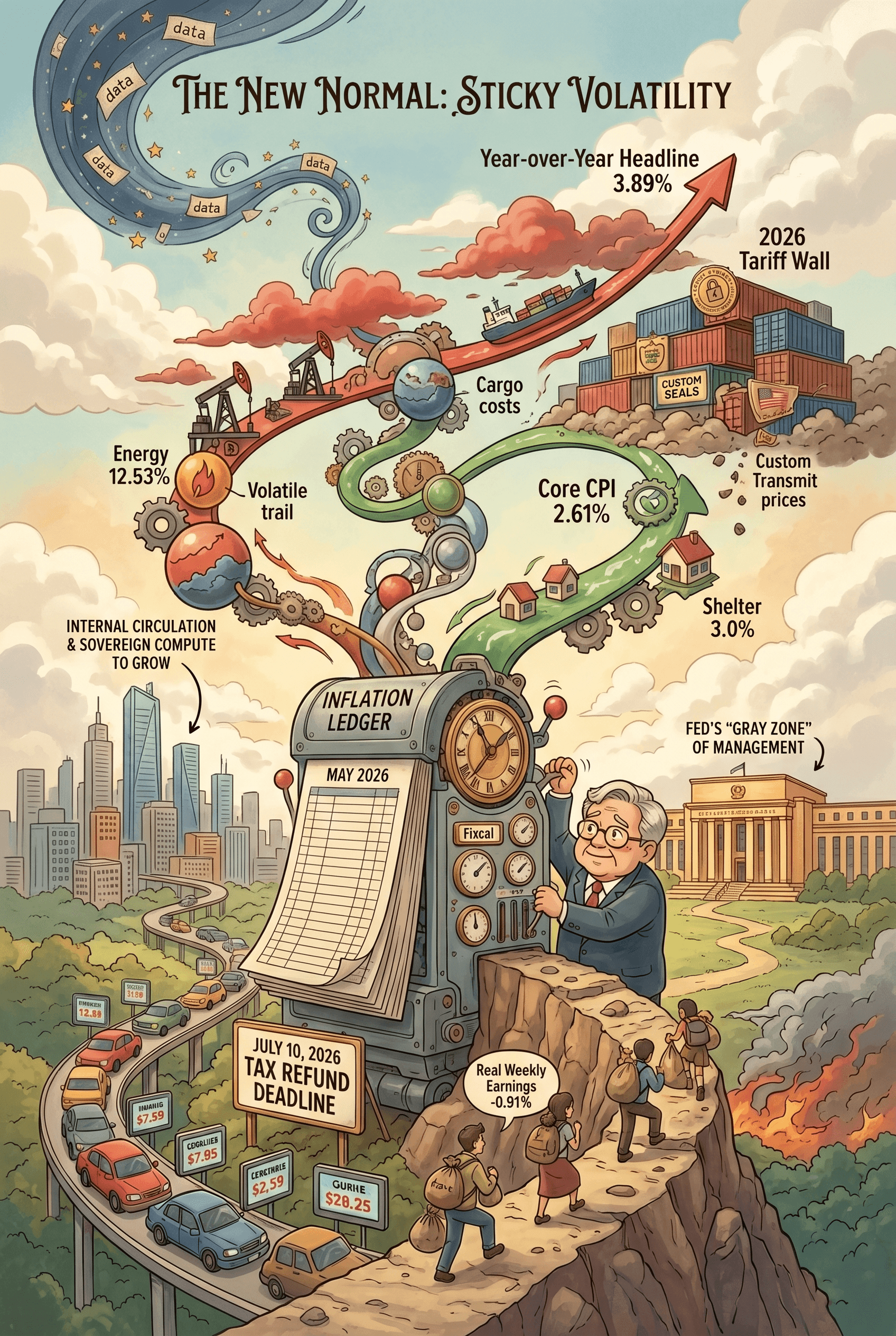
GLOBAL
The Relentless Resistance: Deciphering the May 2026 CPI Report
May 12, 2026· 3 min

GLOBAL
Silicon, Cells, and Scarcity: The 2026 Financial Divergence of MU, DRAM, and PLUG
May 11, 2026· 4 min

GLOBAL
The Pandemic Penalty Paradox: Navigating the July 2026 IRS Refund Deadline
May 11, 2026· 4 min

GLOBAL
The Great Recalibration: Navigating China’s Sovereign Debt Paradigm in 2026
May 11, 2026· 4 min

WEB3
XRP in May 2026: ETF Speculation, Banking Narratives, and the Return of Institutional Momentum
May 10, 2026· 4 min

WEB3
From Small Investments to Digital Economies: How Young Americans Are Entering Web3 Slowly
May 10, 2026· 3 min

WEB3
Why Ethereum Still Attracts Serious Builders in America’s Web3 Scene
May 10, 2026· 3 min